911 and E911
VoIP 911 and E911 for business phone systems
How a 911 call from a VoIP or cloud phone reaches help, what the federal rules require, and what your business needs to keep up to date.
The basics
What 911 and E911 mean on a VoIP phone
A VoIP or cloud phone sends calls over the internet instead of a traditional phone line. When the service lets you make calls to and receive calls from the regular phone network, the FCC calls it "interconnected" VoIP. Interconnected VoIP providers must offer 911 to every customer as a standard feature.
E911 means "Enhanced 911." With E911, the emergency center gets the caller's call-back number and, in most cases, location information automatically.
Location
How a VoIP 911 call finds your location
How a VoIP 911 call finds you
When your address is up to date
Someone dials 911 from a business phone
The call goes through Accent with the phone's registered address
The 911 center sees the call-back number and address
Help is sent to the right place
When a phone moves and the address isn't updated
A phone moves to a new location
The registered address is still the old one
Help may go to the old address
Update the registered address whenever a phone moves.
A VoIP phone can be used from almost any internet connection. So the emergency center cannot tell where you are from the line alone. Instead, your provider keeps a registered address for each phone line.
When you dial 911 with E911, your phone number and registered address are sent to the local emergency center for that address. Some emergency centers cannot receive this information yet. In those areas, tell the operator your phone number and where you are.
Why the address must change when phones move
If a phone moves and its address does not, a 911 call may go to the emergency center near the old address. That center may not be able to help you. The FCC advises VoIP users to:
Give your provider the accurate physical address where each phone is used.
Learn how your provider updates addresses.
Update the address right away when a phone moves.
Tell staff and visitors about any 911 limits on your phones.
FCC rules
The federal rules in plain language
Two federal laws shape 911 on business phone systems. In August 2019 the FCC adopted rules for both. This is a short summary, not legal advice. The FCC pages linked below have the full rules.
Kari's Law: dial 911 directly, and alert someone on-site
Kari's Law became law in 2018. It covers multi-line telephone systems, the kind used in office buildings, campuses and hotels. It applies to systems made, sold, leased or installed after February 16, 2020.
Direct dialing. A user must be able to dial 911 without a prefix or access code, such as 9 for an outside line.
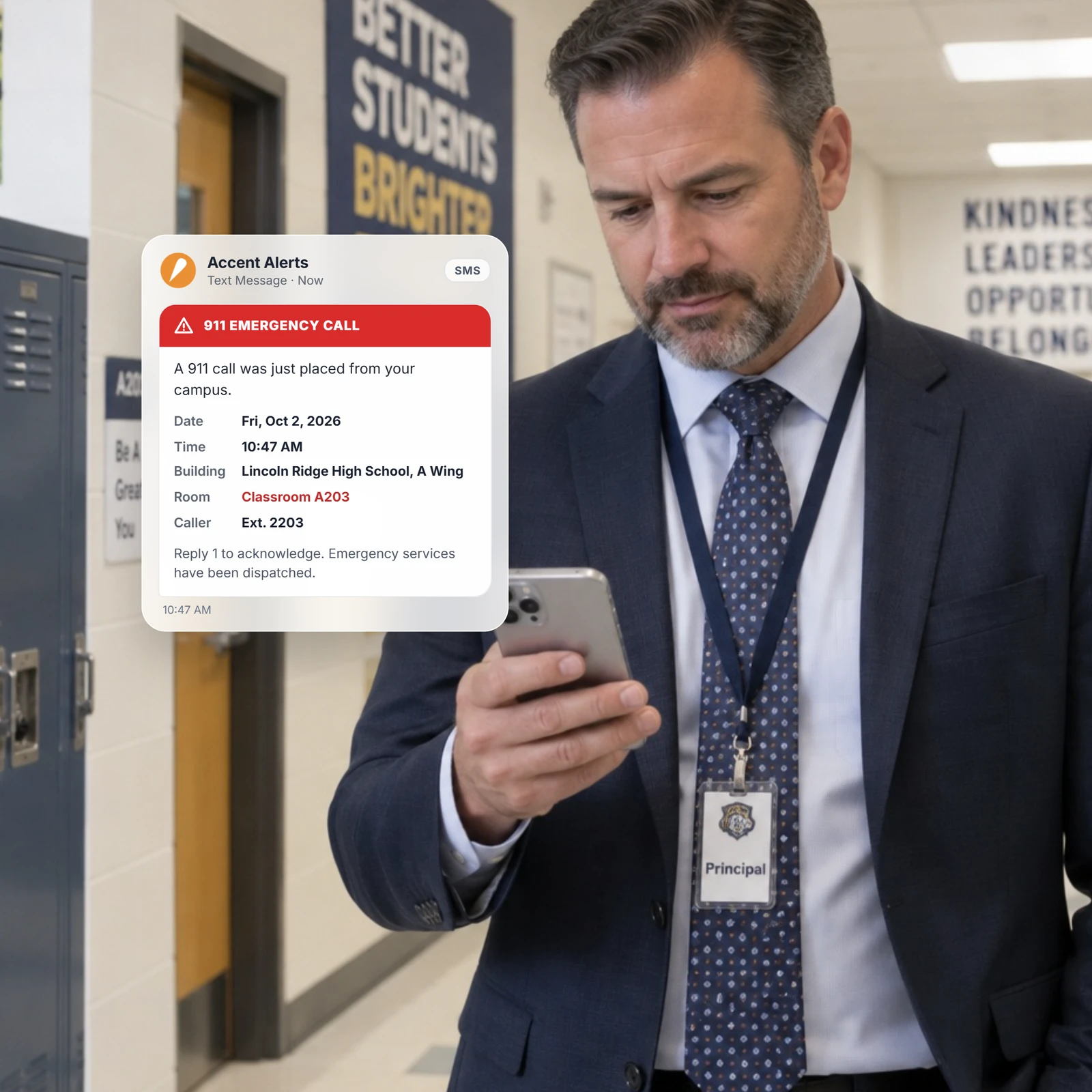
Notification. When someone dials 911, the system must alert a central location on-site or off-site where someone is likely to see or hear it. Examples include an on-screen alert at a security desk, a text message or an email. The alert must say a 911 call was made and, where technically feasible, give a call-back number and the caller's location.
RAY BAUM'S Act: send a "dispatchable location"
Section 506 of RAY BAUM'S Act led the FCC to require a "dispatchable location" with 911 calls. That is the validated street address of the caller, plus details such as suite, room or floor needed to find them.
Fixed phones, like a desk phone that stays put: the location must be sent automatically with each 911 call. For multi-line systems and for fixed VoIP service, the deadline was January 6, 2021.
Phones that move, meaning phones that can easily be used in more than one place, and phones used off-site: the location must be sent automatically if technically feasible. If not, the rules allow a location the user updates, or other location information. The deadline was January 6, 2022.
Read the full FCC rules:
Plan ahead
Limits to know
VoIP 911 does not work during a power failure. After power returns, a phone may need to be reset.
VoIP 911 does not work when your internet or broadband service is down.
Some 911 calls go to a national emergency call center instead of a local one. This can happen if an address cannot be validated, or with certain portable devices. A trained agent asks for your name, number and location, then contacts the local emergency center.
The FCC suggests a backup power supply, a traditional phone line or a wireless phone as a backup.
Accent
What this means for Accent customers
Schools: Accent offers emergency alert features and can design a custom alert plan that delivers emergency notifications to a variety of locations and endpoints. See communication for education.
FAQ
VoIP 911 questions
Does 911 work on a VoIP phone?
Yes. The FCC requires interconnected VoIP providers to include 911 as a standard feature that customers cannot opt out of. It needs power and a working internet connection, so it will not work during a power or internet outage.
What is the difference between 911 and E911?
With E911, your phone number and registered address go to the local emergency center automatically when you dial 911. Some emergency centers cannot receive that information. In those areas the operator may not have your number or location, so you must say where you are and give your number.
How does a VoIP 911 call know where I am?
It uses the address you registered with your provider for that phone line. A VoIP phone can be used from almost any internet connection, so the address on file is what tells the emergency center where to send help. If the phone moves, update the address.
What is Kari's Law?
Kari's Law is a federal law passed in 2018. It requires multi-line telephone systems, like those in offices, campuses and hotels, to let users dial 911 directly, without a prefix such as 9. It also requires the system to notify someone on-site or off-site when a 911 call is made. It applies to systems installed or first sold after February 16, 2020.
What is a dispatchable location?
It is the location sent to the emergency center with a 911 call: the validated street address, plus details such as a suite, room or floor needed to find the caller. Section 506 of RAY BAUM'S Act led the FCC to require it for 911 calls from VoIP and multi-line phone systems.
Does VoIP 911 work during a power or internet outage?
No. VoIP 911 does not work during a power failure, or when your internet or broadband service is down. The FCC suggests a backup power supply or a wireless phone as a backup.